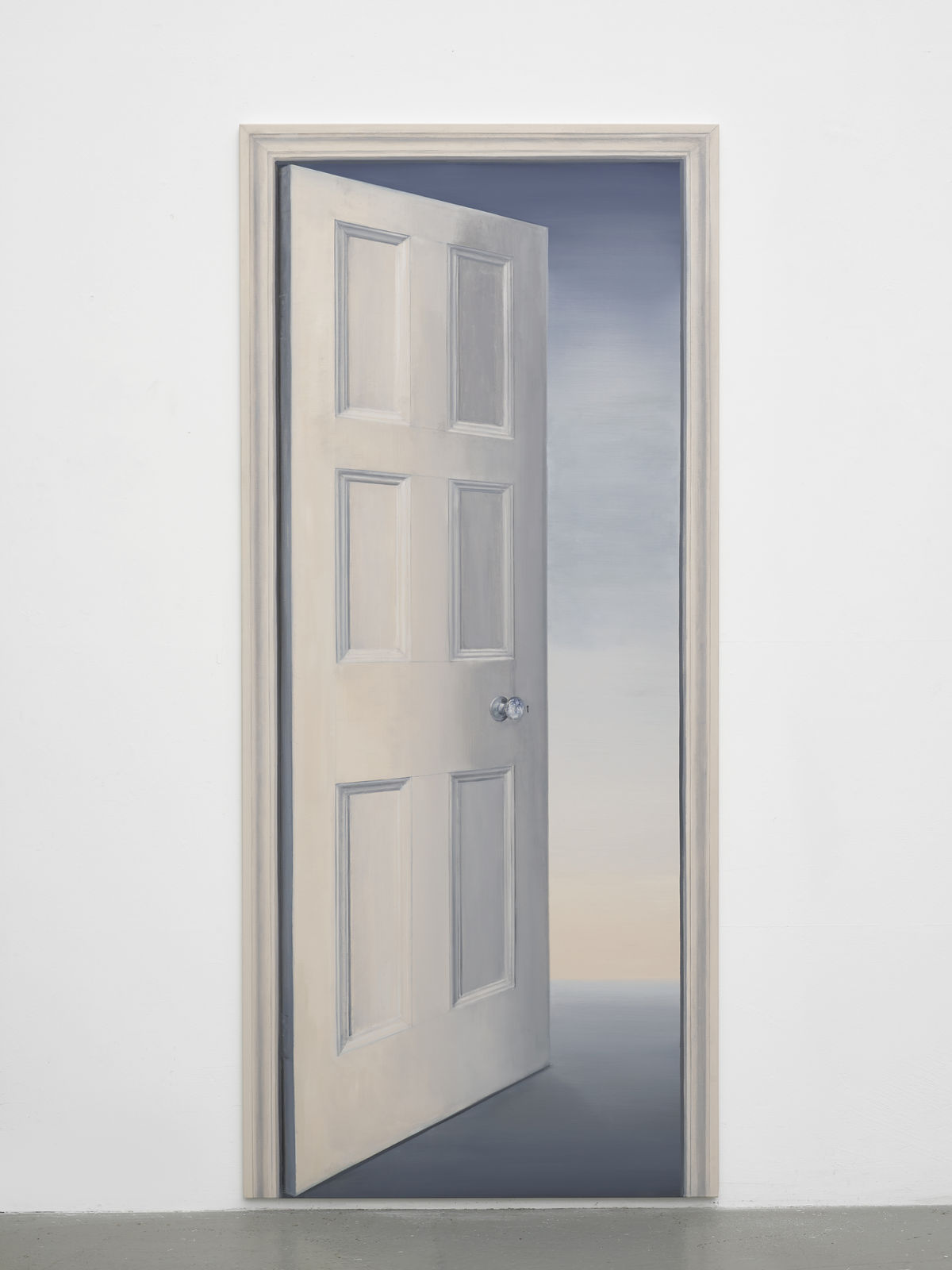
Gavin Turk British, b. 1967
Door (with crystal handle), 2026
Oil on linen
225 x 100 cm. (88 5/8 x 39 3/8 in.)
Copyright The Artist
Door (with crystal handle) (2026) is an oil painting by Gavin Turk that presents a familiar architectural form – a door left slightly ajar, its solid frame rendered with convincing...
Door (with crystal handle) (2026) is an oil painting by Gavin Turk that presents a familiar architectural form – a door left slightly ajar, its solid frame rendered with convincing precision. Set into its surface is a crystal handle, faceted and luminous, catching and refracting light. The detail draws the eye. It suggests touch, weight, and the cool clarity of glass. Yet beyond the door lies no recognisable interior or exterior. Instead, the narrow aperture opens onto a fluid field of paint, where bands of colour dissolve toward a horizon line that hovers between landscape, atmosphere, and pure optical effect. The painting invites approach, offering the promise of entry while continually frustrating any stable sense of space.
Throughout his practice, Turk has returned to ordinary objects invested with symbolic weight. The door, like the egg that recurs elsewhere in his work, embodies paradox. It marks beginnings and endings simultaneously, defining the unstable relationship between inside and outside. Turk has remarked on the visual and conceptual slippage between the two forms and notes “When I see a door in a doorframe, I also see an egg. An egg is all door, in that sense, the door is both a point of departure and arrival.”
Door (with crystal handle) is informed by a sustained engagement with art history. Renaissance theories of painting as a window onto the world echo in the framing device of the doorway, while Surrealist explorations of psychological thresholds linger at the edge of the composition. The work recalls the uncanny domestic spaces of René Magritte and the suspended, metaphysical calm of Giorgio de Chirico. It also resonates with Marcel Duchamp’s Door, 11 rue Larrey (1927), a single door caught in permanent contradiction, both open and closed at once. Turk’s meticulous trompe l’oeil technique invites comparison with Gerhard Richter’s Tür paintings of 1967, in which photographic authority is carefully staged and then deliberately undone.
The crystal handle sharpens the painting’s play between reality and representation. It appears solid, tactile, and precise, almost more real than the painted space beyond. The work shifts the question from what is depicted to how belief is produced. Rather than asking what is real, Door (with crystal handle) asks why we trust what looks convincing. The painting offers no passage beyond itself, only the illusion of one, directing attention back to the viewer’s own expectations and habits of perception.
This concern aligns Turk with a longer philosophical lineage. In The Marriage of Heaven and Hell (1793), William Blake proposed that perception limits reality rather than reveals it, a notion later reframed by Aldous Huxley in The Doors of Perception (1954). Turk’s door does not open onto truth or transcendence. It opens onto the unstable mechanics of seeing.
Door (with crystal handle) holds the viewer at the threshold, caught between belief and doubt, presence and absence. Meaning is not located beyond the opening, but in the uneasy experience of standing before it, aware of the desire to reach for the handle and the impossibility of doing so. The work insists on hesitation, reminding us that perception is provisional, and that what lies beyond the frame remains perpetually out of reach.
Throughout his practice, Turk has returned to ordinary objects invested with symbolic weight. The door, like the egg that recurs elsewhere in his work, embodies paradox. It marks beginnings and endings simultaneously, defining the unstable relationship between inside and outside. Turk has remarked on the visual and conceptual slippage between the two forms and notes “When I see a door in a doorframe, I also see an egg. An egg is all door, in that sense, the door is both a point of departure and arrival.”
Door (with crystal handle) is informed by a sustained engagement with art history. Renaissance theories of painting as a window onto the world echo in the framing device of the doorway, while Surrealist explorations of psychological thresholds linger at the edge of the composition. The work recalls the uncanny domestic spaces of René Magritte and the suspended, metaphysical calm of Giorgio de Chirico. It also resonates with Marcel Duchamp’s Door, 11 rue Larrey (1927), a single door caught in permanent contradiction, both open and closed at once. Turk’s meticulous trompe l’oeil technique invites comparison with Gerhard Richter’s Tür paintings of 1967, in which photographic authority is carefully staged and then deliberately undone.
The crystal handle sharpens the painting’s play between reality and representation. It appears solid, tactile, and precise, almost more real than the painted space beyond. The work shifts the question from what is depicted to how belief is produced. Rather than asking what is real, Door (with crystal handle) asks why we trust what looks convincing. The painting offers no passage beyond itself, only the illusion of one, directing attention back to the viewer’s own expectations and habits of perception.
This concern aligns Turk with a longer philosophical lineage. In The Marriage of Heaven and Hell (1793), William Blake proposed that perception limits reality rather than reveals it, a notion later reframed by Aldous Huxley in The Doors of Perception (1954). Turk’s door does not open onto truth or transcendence. It opens onto the unstable mechanics of seeing.
Door (with crystal handle) holds the viewer at the threshold, caught between belief and doubt, presence and absence. Meaning is not located beyond the opening, but in the uneasy experience of standing before it, aware of the desire to reach for the handle and the impossibility of doing so. The work insists on hesitation, reminding us that perception is provisional, and that what lies beyond the frame remains perpetually out of reach.