Alighiero Boetti Italian, 1940-1994
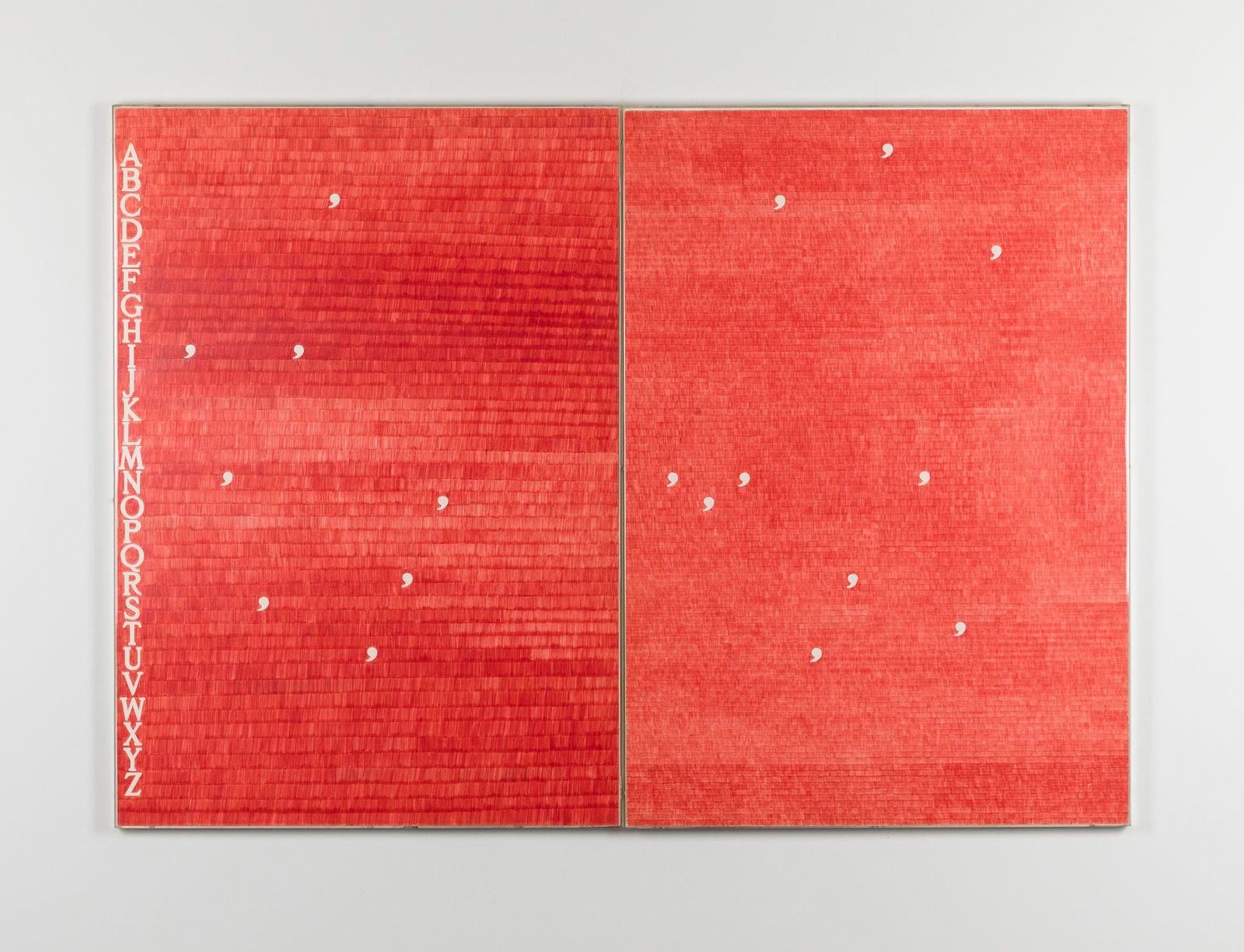
Insicuro Noncurante, 1983
Ballpoint pen on paper laid down on canvas
2 parts, 100 x 70 cm. (39 3/8 x 27 1/2 in.) each / 100 x 140 cm. (39 3/8 x 55 1/8 in.) total
Copyright The Artist
Further images

Alighiero Boetti’s Insicuro Noncurante (1983) forms part of his celebrated series of biro drawings, a body of work in which language, labour and authorship are set into play. Spanning two...
Alighiero Boetti’s Insicuro Noncurante (1983) forms part of his celebrated series of biro drawings, a body of work in which language, labour and authorship are set into play. Spanning two adjoining panels, the composition unfolds as an undulating monochrome field of red biro hatch marks, interrupted by areas left intentionally unfilled. Along one vertical edge runs the alphabet, while a dispersed system of commas fills the surface, operating as a coded structure. When read horizontally, this system spells out the work’s title, insicuro noncurante, translated as “insecure–carefree”. Boetti’s biro works are held in numerous public collections worldwide, including SMAK – Stedelijk Museum voor Actuele Kunst, Ghent; the Museo Nacional Centro de Arte Reina Sofía, Madrid; the Glenstone Foundation, Potomac; the Toyota Municipal Museum of Art, Japan; and the Museum of Modern Art (MoMA), New York.
At first glance, the surface appears almost uniform, dense yet animated by subtle shifts in pressure and rhythm. On closer inspection, these variations register the presence of the hand. Each panel was completed by a different studio assistant, working to Boetti’s precise instructions and drawing every hatch mark individually. This slow, accumulative process is central to the work’s meaning. Insicuro Noncurante unfolds not only across its physical dimensions, but through the hours, days and repetitions absorbed into its making.
Boetti began the biro works in Rome in the early 1970s, developing them from his early involvement with Arte Povera while moving beyond its material austerity towards systems, language and collaboration. Assistants from his local neighbourhood of Trastevere executed the drawings by adhering to clearly defined rules. In Insicuro Noncurante, Boetti specified that alternating panels should be coloured by assistants of different sexes, introducing a measured form of difference and balance into the structure of the work. Authorship is thus dispersed rather than singular. Boetti remains the originator of the idea, but the execution is shared, complicating the traditional notion of the artist as sole maker.
The composition can suggest a star chart or abstract map, yet it also insists on its own arbitrariness. Meaning is present, but only through a code that must be deciphered. The paired words of the title sharpen this tension. Structurally similar yet semantically opposed, they echo Boetti’s long-standing fascination with dualities such as order and chance, control and freedom. In this sense, the work reflects on the instability of language itself. Like many of Boetti’s text-based works, it exposes the gap between words and what they claim to describe, a concern often associated with Ferdinand de Saussure. Here, however, the conceptual framework is filtered through colour, rhythm and repetition, producing a work that operates as both visual experience and intellectual proposition. Insicuro Noncurante ultimately holds its contradictions in careful balance, inviting the viewer to move between reading and looking, certainty and doubt.
At first glance, the surface appears almost uniform, dense yet animated by subtle shifts in pressure and rhythm. On closer inspection, these variations register the presence of the hand. Each panel was completed by a different studio assistant, working to Boetti’s precise instructions and drawing every hatch mark individually. This slow, accumulative process is central to the work’s meaning. Insicuro Noncurante unfolds not only across its physical dimensions, but through the hours, days and repetitions absorbed into its making.
Boetti began the biro works in Rome in the early 1970s, developing them from his early involvement with Arte Povera while moving beyond its material austerity towards systems, language and collaboration. Assistants from his local neighbourhood of Trastevere executed the drawings by adhering to clearly defined rules. In Insicuro Noncurante, Boetti specified that alternating panels should be coloured by assistants of different sexes, introducing a measured form of difference and balance into the structure of the work. Authorship is thus dispersed rather than singular. Boetti remains the originator of the idea, but the execution is shared, complicating the traditional notion of the artist as sole maker.
The composition can suggest a star chart or abstract map, yet it also insists on its own arbitrariness. Meaning is present, but only through a code that must be deciphered. The paired words of the title sharpen this tension. Structurally similar yet semantically opposed, they echo Boetti’s long-standing fascination with dualities such as order and chance, control and freedom. In this sense, the work reflects on the instability of language itself. Like many of Boetti’s text-based works, it exposes the gap between words and what they claim to describe, a concern often associated with Ferdinand de Saussure. Here, however, the conceptual framework is filtered through colour, rhythm and repetition, producing a work that operates as both visual experience and intellectual proposition. Insicuro Noncurante ultimately holds its contradictions in careful balance, inviting the viewer to move between reading and looking, certainty and doubt.